Archive for ‘Critter Problems’

June 13, 2012

Protecting trees from deer

If you’ve been reading for a while you probably know by now that the Minnesota Landscape Arboretum is one of my favorite places on earth.  Occasionally people will ask my why.  The reason is simple, I learn something almost every time I go there.

Last weekend, while my son was planting his garden, I took the trumpeter tram with a friend of mine.  While on the tram I learned many things, but the one I thought most readers would benefit from is a little trick the Arboretum does to protect young trees from deer browsing.

The best part is that it’s extremely simple.  Four re-bar posts placed in a square around the tree.  Check out the pictures for examples.

If you have problems with deer give it a try and let me know how it works!

April 22, 2012

R is for Rodent

Rabbits eat my lettuce

Squirrels steal my pears

Raccoons peak in my windows and freak me out when they stare

Opossum at my back door

Woodchuck under the shed

Garter snakes slither and stop my heart nearly dead

Toads in all directions hopping here and there

Neighbor’s cats adding scents for which I don’t particularly care

Japanese Beetles and June Bugs and May Flies

Might make you wonder why I garden, why I even try?

You might say I like it, or love it at the least

For why else would I put up with these less than sightly beasts?

As I venture outside to plant and weed and water

I realize there’s nothing that rhymes with rodent

I only wish my garden wasn’t their fodder

Kate

October 28, 2011

Selecting and Planting Bulbs

Fall is flying by, but if you’re thinking it’s too late to plant, it’s not!  As long as the ground isn’t frozen you can keep planting.  In fact, fall is the time to plant spring blooming bulbs.

There are a few ways to plant them: individually, clumps, mass plantings or naturalizing.

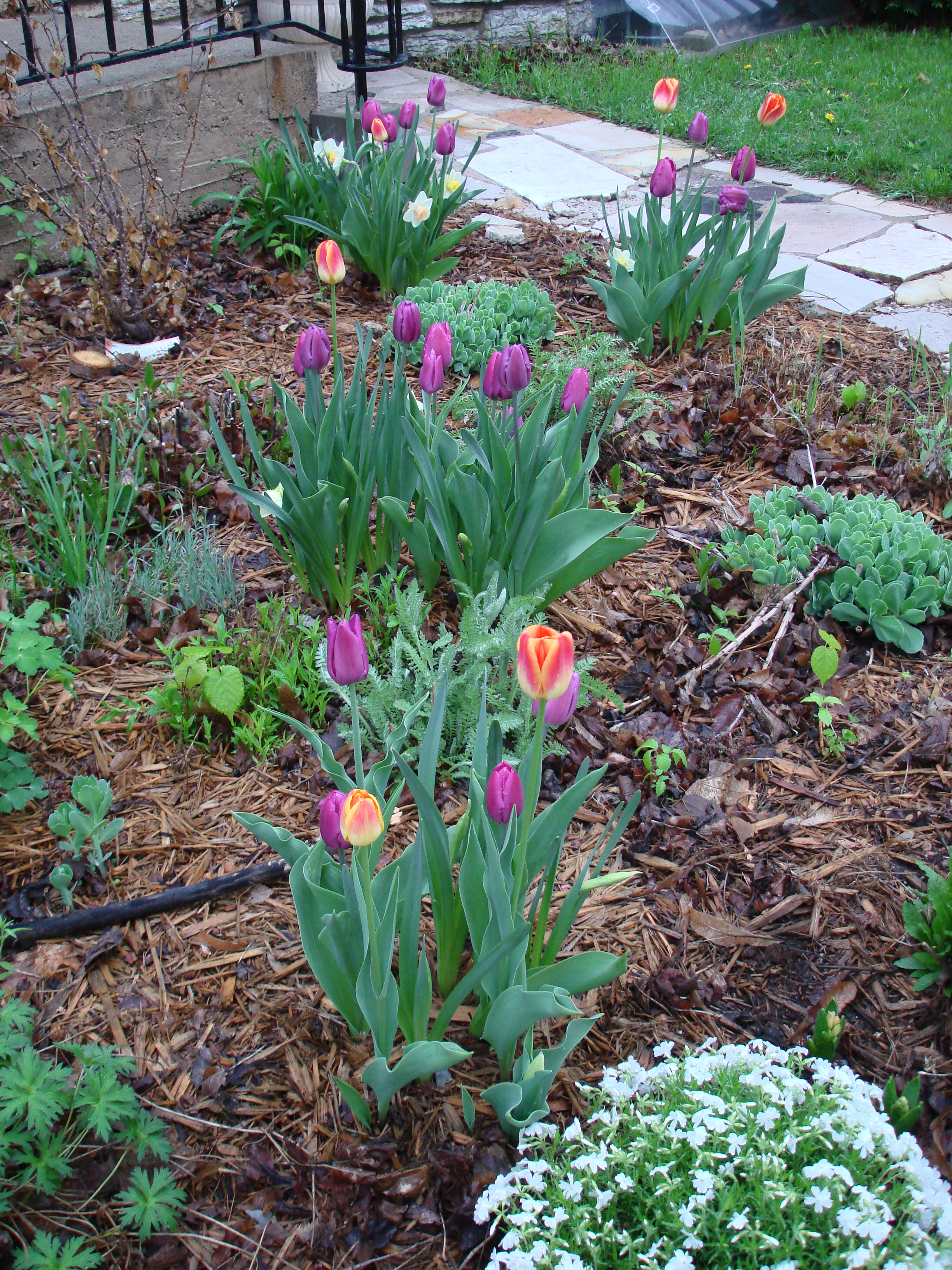
Clumps of Tulips

Clumps of Tulips & Daffodils (shown with Phlox)

But, before we go there, let’s talk about bulbs.  First, I’m going to use “bulb” in loose terms.  There are actually 4 different types of bulbs (tubers, corms, true bulbs and rhizomes).  I won’t go into too much detail here, but they each have different growth habits and needs, which is why you might notice that not all bulbs behave the same way.  Some get better over time, some decline.  It’s in their nature.

There are many different sizes and varieties of bulbs.  When shopping for bulbs, you want to make sure you buy the biggest, healthy bulbs.  First, make sure the bulb is fresh.  Much like a good onion or head of garlic, you want the bulb to look fresh, be firm to the touch and the bulb’s natural paper (tunic/tunicate) should still be on the bulb and be tight.  Also check basal plate (the flat spot at the bottom), it should be firm, not soft.  If the bulb looks dry, has mold, has bruises, insect damage or the paper is gone, don’t buy it!  It won’t produce a good bloom in the spring.

Once you’ve selected your bulbs, be it tulips, daffodils, hyacinth, grape hyacinth, crocus, squill or scilla (the list goes on).  Take them home and decide where you’re going to plant them (if you didn’t have a location in mind already).  Most bulbs are sun-loving, but don’t let that scare you or limit where you plant them.  Keep in mind, bulbs bloom before most trees and shrubs have leafed out, so you can plant bulbs in an area that is typically a shade garden (assuming they are deciduous trees and shrubs and not evergreens).

Once you have selected a site, decide on a planting style.  Many of us grew up seeing individual rows of tulips planted across the front of a house.  While pretty, I find bulbs to be far more stunning and make much more of an impact when planted in clumps, waves moving in and out of other plants or in mass.  In general, bulbs are relatively inexpensive so it doesn’t cost a ton of money to make a big statement in the spring.

Mass Planting of Tulips

Mass Planting of Tulips

Now, maybe you’re thinking, “Are you kidding me? I’m not going to plant a lot, they are such a pain to plant!”  That used to be the case when all the only option was a garden trowel, but now there are tons of bulb planting tools available to make the job easier: bulb planters, bulb trowels, bulb (hand) augers, bulb augers for drills, pick axes, you name it.  However, unless you have really hard soil, want to plant each bulb individually for old times sake or want to have them spaced a specific distance away from each other for a mass planting, I think it’s easier to just grab a shovel and dig a hole (or a trench as the case may be).

If you’re not sure how deep to dig the hole, the rule of them is to plant bulbs 2 – 3 times deeper than their width, for example if you’re planting a bulb that is 2 inches across, you would dig a hole 6 inches deep and wide enough to fit the number of bulbs you want to plant plus room between each one so they don’t touch each other.  Plan on an odd number of bulbs in each hole because odd numbers are most appealing to the eye.  And as far as quantity goes, I would recommend 9 – 11 bulbs to achieve the most full, natural looking clump for large bulbs (tulips and daffodils) and more for smaller bulbs/corms.

If you’re thinking about naturalizing bulbs, there are a few things to keep in mind.  Some are definitely better than others for naturalizing because they will naturally multiply over time (daffodils, crocus, grape hyacinth, narcissus, squill, lily of the valley).  Some of bulbs come to the surface and will need to be replanted every few years (grape hyacinth for example) because they continually “use up” the original bulb/corm and grow baby bulbs/cormals above the original bulb and then some bulbs will sink – yes, sink… their roots, called contractile roots, naturally pull them deeper and deeper into the soil each year (as with crocus).  Others (most tulips) are sterile, in other words they won’t reproduce and will need to be replanted each year, therefore not making good naturalizing bulbs.  The exception would be “species tulips”, which are typically smaller.

Mass Planting of Tulips II

Mass Planting of Tulips - MN Landscape Arboretum

Back to planting… Once the hole is dug, mix a little bone meal (to feed the bulbs) into the soil in the base of the hole, then place the bulbs in the hole.  When placing the bulbs there is typically a flat or flat-ish side (called the basal plate) this is the end that you will find dried roots.  The other end (top) is typically pointed.  Place the bulb pointed side up and make sure there is soil between the bulbs so the bulbs are not touching or they will rot.  Once placed, cover with soil and water well.

If you like to mix bulbs, for example daffodils and tulips in the same hole, not a problem.  “But wait!” you say, “My tulip bulbs are bigger than my daffodil bulbs.  How deep do I dig my hole?”  Here’s the trick.  Did the hole deep enough for your tulips, plant your tulips as explained above, then put a shallow layer of soil in to the hole (an inch or so) again, so the bulbs don’t touch, then plant your daffodil bulbs.  “But what if I plant one right on top of the other without knowing it?” Not to worry, plants are pretty smart.  They’ll work their way around the upper bulbs and make their way to the surface just fine.

Squirrel problems? I’ve heard a lot of people complain about squirrels “un-doing” all their hard work.  Nothing is more frustrating than throwing soil on your last hole, dusting the dirt off of yourself, only to look over and see the squirrels have already relocated your bulbs!  There are a couple of tricks when it comes to squirrels.  Typically squirrels are not a fan of daffodils because daffodils are in the onion family… so…. if you plant daffodils above your tulips there is far less chance of them digging them up.  Another method of protection is to add a piece of chicken wire above the bulbs between layers of soil to prevent them from digging.  Again, the plants will find their way through and the squirrels will most likely be frustrated and move on.

So there you have it… bulbs 101.  I expect to see pictures in the spring! 🙂

Kate

July 22, 2011

It’s been a while…

It’s been a while since I’ve posted.  Weeks, I think.

Life has taken me for a bit of a ride lately which I won’t go into detail about, but I hung on, kept my arms inside the car at all times and managed to make it through.  There’s a break in the action, so I figured it was a perfect opportunity to post.

We’ve had the absolute craziest weather in Minnesota the past couple of weeks.  We’ve had hot, we’ve had torrential downpours, we’ve had tropical rainforest humidity. Hopefully everyone’s garden is flourishing.  My garden is great!  And no so great…

Where to start?  The kale has been beautiful. It’s loved the weather and I’ve loved it back by eating everything that’s grown thus far.  The cabbage is starting to form heads.  I only planted red cabbage this year (my favorite) and aside from a couple of bugs doing a tiny bit of dining they are coming along nicely, as are the tomatoes and peppers. The asparagus is outgrowing its space, but is absolutely beautiful, its soft feathery stalks add grace to the garden. Cucumbers, squash and melons haven’t produced much fruit yet, but I planted them late, so their blossoms should drop and fruit should form any day now.  What else?  broccoli.  Ahhh broccoli. Big, tall, handsome broccoli has, well, nothing… yet.  It might be another year of “not so much” in that category.  The raspberries, on the other hand, were loaded.  They loved all the early rain, plumped up well, then we got more rain and intense heat and many turned to mush right on the canes.  Bummer, HUGE bummer!  The fruit that originally formed on the kiwi is gone.  Not sure if conditions were wrong and they dropped off or if critters just stole them.   Pear trees bloomed beautifully, but only produced about 20 pears (compared to over 100 that the squirrels dined on last year).  They’re still growing so I’m hopeful, but not confident, that we’ll get one of them this year.  Apples… nothing.  My neighbors have had great success with theirs this year, ours have had great success with bugs.  Not sure what yet, because I haven’t really had the time to investigate, but something got to them before they could even produce fruit.  Onto the grapes.  The grapes are flourishing.  They’ve grown at least 15 – 20 feet long this year and are loaded with fruit.  Until a week or so ago they were lush and beautiful.  That was until the onslaught of Japanese Beetles arrived and turned most of the leaves into lace.  I have many names for the Japanese Beetles, but I won’t write them here.  Thankfully they like the foliage more than the fruit, so other than pooping on my grapes (and raspberries), they didn’t harm them.  And nasty as that is… it washes off.

So what did I do about the beetles besides swear at them?  I blasted them with the hose.  Unfortunately that only got them excited, made them flurry around even more and land right back on the leaves.  Prior to this year I’ve never really had much of a problem with Japanese Beetles.  I interplanted curly parsley with my roses, which did a pretty good job of keeping them away.  I could also pick them off the other plants they were bothering.  Until now, I haven’t even felt the need to make insecticidal soap (a nice little concoction of soap, water, garlic, cayenne pepper, etc.).  Although I thought about it, I didn’t spray them, mostly because the plants they were attacking have fruit so it would make picking stuff right off the vine soapy, spicy and well, garlicy.  Yes, it would wash off, but there’s something about picking fruits and veggies right off the vine and eating them immediately that I just love.  Besides, there were so many beetles I would have needed to call in the armed forces to come in and blast them away, so I left them.  I left the nasty, metallic backed, over sexed little beetles to eat my leaves.  And now…. they’re gone.  The plants look awful, but are all recovering. The scary part is, they are now laying eggs in the soil, breeding the next batch of beetles, which will eat the roots and shoots of grass, the garden and anything else that appeals to them.

Basil!  I got so distracted by the beetles I almost forgot to mention the basil!  It’s gorgeous and full and needing pinching practically every day to keep it from going to seed.  I love basil!  And tonight, on my break in the action night, I’m going to make bruschetta.  I have a couple of tomatoes from the farm stand (because other than cherry tomatoes, mine aren’t quite ready) I have basil and need to run and get some garlic.  Friday Farmer’s Market is open for a couple more hours so I’m going to swing by and see if they have garlic (because I didn’t plant any of my own) and grab a baguette.  Then I’ll come home, whip up a little bruschetta, kick back with a book and a glass of wine and enjoy.  I can taste it now.

Ahhhh…. summer, it doesn’t get any better than this.

Kate

p.s. – Did I mention I have bunnies?  Uh, huh.  Two for sure… INSIDE the fence around my garden.  I know I’ve talked about living in harmony with nature, but by harmony, I wasn’t thinking I would give them a home inside the garden.  While enjoying my bruschetta and wine tonight I’ll also be trying to figure out a way to encourage them to leave my garden.