September 14, 2011

Jack Frost is lurking – what’s your plan?

The first frost of the season is threatening to strike the Twin Cities tonight.

The low is supposed to be around 35 degrees and frost advisories are out.  Even though it seems early and like fall came rushing in, it’s really right on target.  The average first frost date in this area is September 15th (another date for your garden calendar), and today is the 14th.  Not too far off.

So, what does that mean for gardeners?  It’s almost time to put things to bed as our growing season is about to come to a close.  There may still be some warm, sunny days left in the forecast as well as some warmer nights, but for now it’s best to take precautions or say your good byes.  If you’re new to gardening that means it’s time to either cover or bring your tender plants inside.  Tender?  What’s tender?  Basically any plant that doesn’t like the cold weather is considered tender. Remember warm season and cool season plants discussed earlier in the spring?  The warm season plants are also typically called “tender”.  Tender plants are also typically annuals.  And they are called annuals because they will typically only grow one year in our climate because they are usually a Zone 9 or Zone 10 plant (we’re Zone 4).  Long story short – tender plants/annuals like warm weather and frost is not their friend. One example of a tender plant is basil. If basil gets snapped by frost you will definitely know it!  One day you will have a lush emerald-green plant and the next you’ll have a sad, black and droopy mess dangling on sticks.  Another example would be begonias and impatiens (and other succulents) – one cold night and they will turn limp and mushy.  Lovely!  Tomatoes are another one that need to either be covered or picked.  Even if they are green, pick them and put them in a sunny windowsill.  They will ripen and still taste MUCH better than what you’ll find in the grocery stores.

Whether I bring things in or let them go depends on a few things.  Do I LOVE that plant and want to hang onto it for a while or did it “not quite” make the grade this year?  What’s the forecast?  Is it going to be pretty cool during the upcoming days followed by cold nights (in which case any warm season plants are going to put the brakes on and call it quits any way) or is it just one or two cool days followed by a warmer forecast where they still might “perform” for a while?  OR am I pretty much just “done” for the season? The ratty plants – yep, goners.  The average plants – it depends, if they’re common (petunias, impatiens, etc.) I usually let them go.  However, if it’s a new cultivar or somewhat interesting and can make it as a house plant for the winter, well then, they are welcomed inside!  I thank the rest for the beauty and fruit they offered this year and bid them farewell.

One thing to keep in mind – perennials are pretty tough.  They can handle our weather, which is what allows them to be perennials here.  The majority  do not need any special treatment.  No covers, nothing.

So here’s my plan for tonight… I’ll be grabbing some of my potted herbs and other funky (meaning cool) plants and giving them a home inside; cutting a bunch of basil to make a couple of recipes including pesto to freeze and use through the winter; grabbing the tomatoes, peppers and the like (which will also get gross if nipped by frost); then covering the remaining basil, peppers, etc. with sheets and hoping for the best on the rest.

Good luck – say “Hi!” to Jack if you see him.

Kate

September 13, 2011

Time for an evolution

There are times in life where whether you think you’re ready or not, life pushes you forward.  This is one of those times for me.

Not quite a year ago I made a pretty significant job change.  I switched out of an industry I love into completely unfamiliar territory.  What was the draw? I’d been offered a job working with an old flame of mine.  Foreign language. (German to be specific).  Although I was scared to make the jump, I knew I needed to do it.  I’d gone as far as I could where I was and knew I had to give myself a chance at something new.  I took the leap and landed in, well, muck.  I was now standing in an industry that was completely foreign to me, focusing on customers that speak a language I once knew much better than I do now, barely knowing which end was up.  It was exciting at first, but still my heart and feet felt heavy.  Not only did I need to learn the new industry, its players and its lingo, but I also needed to figure out how the heck to translate all of it in German!  It’s one thing to talk about where you’ve been, what you’ve seen and how to order a beer in a foreign language, but it’s an entirely different gig to speak business lingo regarding something you just learned in your native tongue the day before.  Amazingly enough I came to understand the new industry and the cobwebs started to come off and my German vocabulary was growing.  I was even communicating with my German customers entirely “auf Deutsch”. But life isn’t a fairy tale.  I didn’t love it.  I loved the German part, but I was in Sales and really missed the creative side of what I used to do (Marketing) in an industry I loved (Landscaping).  So, a couple of months ago, I made another change.  After straddling the fence for a little while between Marketing and Sales, I eventually made the shift into Marketing.  Ahhh, that felt better!  Although I was missing the German interaction, the creative juices started flowing again and my spirit started lifting.  You might think the story would end here but it doesn’t.  (This is where that push from life comes in.)  About a week ago circumstances changed again and my Marketing role has been scaled back to a part-time deal.  At first I wasn’t sure what I would do, then a little voice inside me said – “let go of the safety net and go for it”.

That brings me to today. Rather than pursuing a second part-time or a full-time gig for someone else, I decided that I’m going to trust in myself and start free-lancing again.  In addition to landscape and garden designs and consultations, my plan is to expand into marketing services such as web, blogging, photography, etc.  I’m not entirely sure at this point what it’s going to look like or where it’s going to take me, but honestly, I’m extremely excited about this new opportunity I’ve accepted and look forward to working with and for myself.

I have a lot work ahead of me but expect to see a new website (or two), far more frequent postings from Walnuts & Pears and who knows what else.

So there you have it.  The beginning of another evolution.

See ya tomorrow!

Kate

August 12, 2011

Mother of a Butterfly

For the past few weeks we’ve been caring for another life our house.

It all started on Monday a few weeks ago.  My son brought home his harvest from his children’s garden at the Arboretum.  As he was showing me all the vegetables and flowers he’d harvested, he spotted a caterpillar.  It was crawling on one piece of the vast amounts of dill he’d brought home.  How he spotted it, I’ll never know.

We decided to keep it.  We transferred the caterpillar, along with a few pieces of dill, into a little cup.  He covered the cup with plastic and poked a few air holes in it.

Caterpillar in a cup - for perspective

We continued feeding it fresh dill and cleaning its home daily (we learned caterpillars poop a lot) and literally watched it grow before our eyes.

Caterpillar, dill (and poop)

Having never kept a caterpillar for more than a couple of days, we found the entire transformation absolutely fascinating.  At first it was pretty small and didn’t have a lot of color, but after shedding a couple of layers of skin its color became more and more vivid.  It’s black body had cream-colored spots and bright green stripes.

After less than a week the caterpillar outgrew its little cup so we transferred it to a butterfly/bug box my son had gotten when he was younger.  In its new home the caterpillar continued to dine on its daily buffet of fresh dill until one day, about a week ago, it just stopped.  It stopped eating, it stopped moving.  It scrunched itself up and only moved if we (unintentionally) startled it and at that, it would only flinch.

Preparing to cocoon

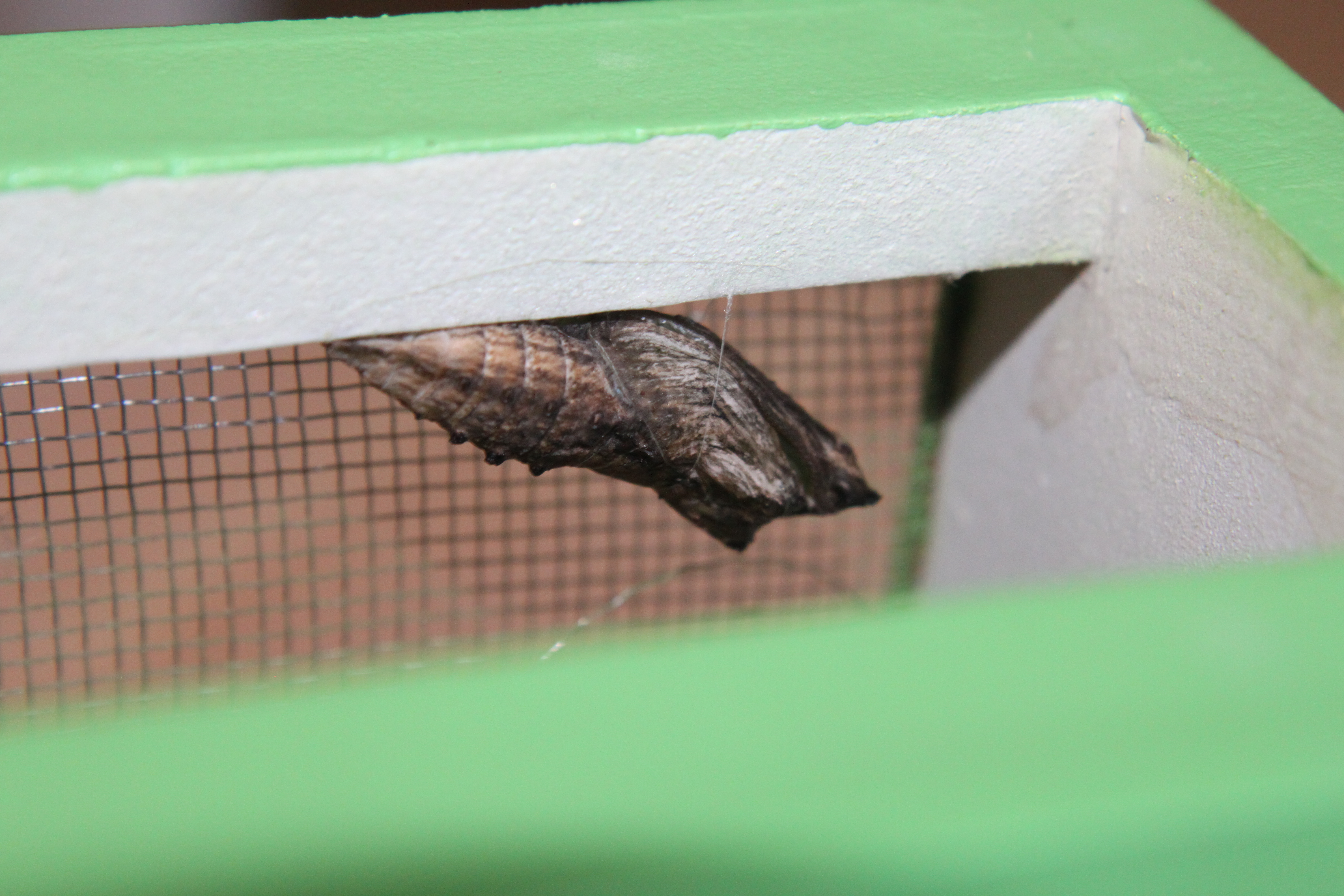
After a day or so, it formed its cocoon/chrysalis and there it stayed, attached to the upper part of the butterfly box, for at least another week.

Cocoon/chrysalis

This morning, as I was reaching for a cup of coffee, my son screamed. I jumped, my coffee starting doing acrobatics in the air and amazingly enough, every drop landed back in my cup.  When I turned to see what he was screaming about, he was pointing to the butterfly box, shouting “Mom, look!  Look!  I knew it!  I knew it would be a butterfly!”  And so it was.  Black, light spots, trademark tail.  We’d guessed right.  Our caterpillar was a swallowtail.  At first he was disappointed. “Mom, it doesn’t have the blue like we thought it would.”  We’d spent a little time, looking at pictures of swallowtail caterpillars and butterflies on the web, so he had in his mind what it would look like.  It wasn’t there, yet.  I reminded him that it takes a little while for the color to fully develop on their wings.

Newly emerged Black Swallowtail butterfly

After admiring our butterfly in the kitchen for a little bit, we decided it was time to release “him” (we found out later “he” was actually a “she).  So, outside we went, searching for a good spot.  We tried a little zinnia my son had grown from seed but it seemed a little too small.  We then contemplated between milkweed and a few other flowers.  At last my son decided on the phlox.  We gently transferred him, then headed inside to finish “getting ready”.

Black Swallowtail on phlox

About an hour later I thought I’d check up on our butterfly and see if he’d flown away yet.  I peeked out the window but couldn’t see him.  I decided to go out and look. I found him, not on the phlox, but on the ground fluttering around.  My heart sunk.  Oh, no!  I’d seen the neighbors cat in our yard earlier, I was fearing our butterfly had been used as a kitty toy.  I gently eased him onto my finger. He appeared to be untouched.  I tried to transfer him onto some plants but he didn’t want to go. He kept turning around and walking up my finger and onto my hand.  Finally, I transferred him.  This time to one of the milkweed leaves.  Periodically I would look out the window and see him, still clinging to the milkweed.

Black Swallowtail on milkweed

Later, I peeked out again and didn’t see him.  Again, I went out to find him on the ground. Crap! Did we do something wrong?  Did his wings not grow properly?  What happened?  I eased him onto my finger again, checking him over.  Everything looked okay.  The body of the butterfly was shaking, it had been all morning. My son had noticed the shaking early in the morning and asked me why it was doing that.  I had no idea, I’d assumed it was like a colt standing on shaky legs for the first time.  Maybe he needed nectar? A little sugar to give him the energy to fly.  I set him on the phlox again where his tongue could easily reach for food.  He didn’t eat.

Black Swallowtail on phlox... again

I got distracted (as I often do).  I saw a bee in another phlox and since I just happened to have my camera on me, I started taking pictures.  When I turned back, the butterfly was gone.  I searched the ground fearing I’d bumped him and knocked him off the flower inadvertently.  He was nowhere to be found.  That’s good, right? He was gone. He must have flown away.  Good for him.  Sort of.  I have to admit, as silly as it sounds, I was a little disappointed that I didn’t get to see him take off.  It felt kind of like your child leaving without saying goodbye. I know, I know… It’s just a butterfly.  But still.

Since the weather is so beautiful this week, I’ve been trying to take advantage of it and get outside as much as possible.  I decided to have my lunch outside today (in hopes I might see our butterfly again).  It just so happened that as I was just about to sit down, out of the corner of my eye, I saw fluttering!  I glanced up to see our butterfly – black with beautiful blue and splashes of orange. He fluttered by, sat on my son’s zinnia just for a minute, flapped his wings, then was gone.

That’s what I needed.  I just wanted to know that he was okay.  I smiled.  A proud mom… of a butterfly.

Kate

July 27, 2011

Edible weeds #3 and #4

As the growing season continues, so does the growing season for weeds.

At their peak now, in Minnesota at least, are edible weeds #3 and #4: Purslane and Stinging Nettle.  I have to admit, aside from snacking on Purslane I haven’t “really” eaten these yet, as in a meal, but will in a matter of hours.

As I’ve mentioned before, my son has a garden at the Arboretum.  It’s through him that edible weed #3 was brought to my attention – Purslane.  He came home from his garden day with a huge harvest of a spreading succulent called Purslane.  My first thought was “Okay, what are we going to do with this?”  His response?  “Eat it!” Since then he’s been spotting it throughout our garden, yard, containers, pretty much everywhere we go.  After doing a little investigation and having a few samplings, I’ve determined we’re most likely going to have it in a salad or on sandwiches (or both since he’s harvested so much of it).  You can also stir fry it, steam it, put it in soups… the list goes on. It is, of course, loaded with nutrients too, so while you weed your garden, you can harvest your next dose of vitamins and minerals. Two birds, one stone.

Edible weed #5: Stinging Nettle.  Yikes!  Anyone who has inadvertently run into stinging nettle can attest to the fact that well, it stings!  I’ve done it more than a couple of times in my life and sadly, yes, I’ve felt the pain each time.  (You’d think I’d learn, wouldn’t you?)  Most of the time when this happens I’m irritated with myself and while running cool water on my hands, arms, etc. I think “Why?  Why do we have this plant?  What is the point?”  The point is… again… they’re good for you and from what I understand, quite tasty.  How to harvest these without pain?  The first step is to wear gloves!  Next go down to about the 3rd set of leaves, then clip the stem.  Throw them in a paper bag for safe transportation and if drying, you can leave them right in the bag.  Otherwise, nettle can be blanched (boiled briefly then dropped into ice water) and used in a variety of ways.

Funny isn’t it?  The more you know about a weed, the less “weedy” they become.  It’s all about perspective… 🙂

Weeds.  Get to know ’em.

Kate