April 21, 2014

Thanks to Cancer

Cancer is such an ugly word. It brings fear, pain, suffering both physically and emotionally. It’s scary, especially if you’ve seen it’s work on yourself, family, friends or loved ones. For a lack of no other way to put it, Cancer sucks.

Thanks to Cancer, I’ve watched far too many friends and relatives suffer.

Thanks to Cancer I’ve walked around half of my life fearing that I will get it or my parents or family or friends will get it.

Thanks to Cancer, I’m afraid to die.

But it dawned on me this morning, that what if Cancer isn’t that bad? I often question whether it’s the Cancer that is making people suffer or the way we “treat” Cancer that makes people suffer.

Over the past few years, I’ve become aware of other “non-traditional” ways of treating, not Cancer, but the body, and the more methods I hear about and the more I learn, the more it makes sense.

I’ve mentioned the film The Gerson Miracle before, I’ve mentioned The Gerson Institute before, and I may have mentioned the film Ayurveda before as well.

The Gerson Institute is based on the studies of Dr. Max Gerson from the 1920s and his findings that juicing and a plant based diet can cure certain types of Cancer.

The film Ayurveda speaks to our bodies being in balance and if they are out of balance we will have illness and disease. One of the most interesting in that film to me was a statement that Western medicine treats Cancer, with Ayurveda, they understand that something in the body is out of balance, therefore it becomes a hospitable host for Cancer. If you correct that imbalance and bring the body back into balance, then the Cancer will leave because the body will no longer be a hospitable host. In Ayurveda, they heal the body with plants as well.

If you are familiar with Paul Stamets, you know that he also discovered though his study of mycillium that the Turkey Tail mushroom is an effective treatment for breast and prostate Cancer. A number of University studies have been conducted since his original findings to support this theory. Mushooms, another plant, or in this case, fungi, treating Cancer, or treating the body, getting rid of Cancer.

I spend a lot of time thinking about plants and soil: the healing properties of plants for soil; the effectiveness of growing plants in healthy soil versus dead soil.

I also spend a lot of time thinking about the healing properties of plants for people and the health and liveliness of people who are “on” plants.

The more I learn about this, the more it gets me thinking about Cancer.

This past weekend I learned of another family member getting diagnosed with Cancer. And it got me thinking again.

Cancer is scary. It’s scary because it can be terminal, but the reality is that life is terminal. So why is Cancer so scary? Is it because we are afraid of pain? Is it that we are afraid of suffering? Or is it that we are afraid to die?

This may sound crazy, but what if Cancer is a sign? A stop sign, or more specifically, a stop light. The yellow in the stop light of life.

What if we are driving down the road of life and see an intersection in the distance, we continue on, and about a half of a block away from the corner we can see that the light is green, but as we approach the intersection the light turns yellow. When we see the yellow light we are given a choice: we can glance at the light, look both ways, proceed through through the intersection with caution and continue down the road or we can take our foot off the gas, slow down, stop for the red and wait for the light to turn green again.

What if Cancer is that yellow light? What if Cancer is trying to get our attention on not only a personal level but also a larger scale? What if by offering us the yellow light it is trying to send us a message? What if it’s trying to tell us something in our life isn’t working? What if it’s trying to get our attention so that we slow down and make some changes before we proceed? What if it’s trying to get us to think, to trust our gut, to trust our judgement and make changes in our personal lives, our diets, our environment and in our world?

I’m sure I’m not alone in wondering why there is so much Cancer in our world. What if the answers aren’t as difficult as we think they are? What if we all know what needs to change but instead of looking up at that yellow light we’ve been accelerating through the intersection hoping for the best and saying a little prayer that we don’t get hit?

What if we are in control of whether or not we get Cancer and what if we are in control of fixing ourselves if we do?

A few people have asked me what brought me to IIN to do the Holistic Health Coaching program. The answer is that I have always had an interest in plants, growing food, health and wellness, but the driving force that got me into IIN was that I’m tired of watching my friends and family suffer from Cancer and the treatments for it. In my heart I believe there is another way, a better way. I believe that prevention is a key part of it, but I also believe that it’s never too late to change.

I believe that as more of us become aware of that yellow light, it will be easier to help each other change and we will create change on a larger scale.

Thanks to Cancer, I’m in IIN and want to be a Holistic Health Coach because I want to be a part of that change. I hope somewhere along the line I inspire you to be a part of the change too and that you, in turn inspire someone else.

Kate

March 24, 2014

The New Me

Last week I officially started my program to become a certified Holistic Health Coach with the Institute for Integrative Nutrition.

As part of our program, we needed to set our intentions for the next year, describe our vision and descriptive words of how we see ourself in that vision. I typically find myself to be more productive when I put my intentions out into the Universe, so I thought I would share those on my blog.

In March of 2011, after working in landscaping and gardening for 11 years, I got the urge/calling/message to start a blog. While trying to figure out a blog name that resonated with what I was doing at the time. I also wanted to find one that resonated with who I am and what I want to be doing in the future. I finally settled on Walnuts n Pears, stemming from a 17th century English proverb, “Walnuts and pears you plant for your heirs.” This proverb spoke to me because it encourages us to be mindful of how we live and be conscious of what we are leaving for future generations. In other words, it encourages us to live sustainably.

The concept for Walnuts n Pears originally started as a vision to open a physical space for people to access information on all things related to living a centered, healthy and fulfilling life. My vision for the physical space will have a kitchen, classroom, yoga/meditation space, art studio, greenhouse and outdoor edible gardens. In March of 2011 phase 1 began when Walnuts n Pears (the blog) was launched. The goal was to have a virtual space to share information on landscaping, gardening, harvesting, cooking, preserving, eating and healthy, mindful living.

Phase two and my intention: I am building a successful business helping myself and others eat, grow and be well by being an inspiring holistic health, wellness and gardening coach, offering classes, workshops and seminars in holistic health, wellness and nutrition and as well as sustainable, organic and abundant, edible gardens.

The descriptive words that resonated with me:
elegant
loving
caring
inspiring
calm
peaceful
example
successful
natural
confident
Zen
Buddha
centered
grounded
healthy
fit
respected
strong
balanced
compassionate
prosperous
abundant
spiritual
organic beauty

I look forward to everything else I will be learning and connecting with all of you in the coming year.

Kate

March 11, 2014

Renegotiating Environmindful Monday and Tip #14: Why You Don’t Want To Use Fabric Softener

You may have wondered what happened to Environmindful Mondays.  Well, quite honestly, I did too. After doing a little reflecting I realized that the reason I haven’t been posting isn’t because I ran out of environmental posts but instead because I realized that with some of the posts and things I’ve been doing in my home, I realized I was missing pieces of the puzzle to be able to fully explain why some of these topics are important, which I think is crucial to making change.

If we make a change in our lives just because someone told us we should but we don’t understand why we are doing it, chances are it won’t last.  On the other hand, if we understand a situation/problem and understand how we fit into or contribute to that situation/problem, then it makes it easier to understand why we should change and what the impact is if we choose not to.

For example, let’s say a friend says, “You should really stop using fabric softener.”  You ask why and the response is, “Because I heard it’s bad.”  At first you think, “Oh, geeze. Okay, my friend says fabric softener is bad. I’d better stop using it.”  So you do.  Time goes by and you forget the conversation with your friend.  You forget the details (because there weren’t any).  Over time you start to miss the scent of freshly washed clothes and start getting annoyed with static.  Or, maybe your spouse asks, “What’s so bad about it?”  You can’t remember.  You can’t justify your decision, so chances are you’re going to buy fabric softener and start using it again.

Environmindful Monday Tip #14: Why You Don’t Want to Use Fabric Softener

On the other hand if your friend says, “You might want to reconsider using fabric softener.”  You ask why and the response is, “There are a lot of dangerous, and even, toxic chemicals in them.  Some cause asthma, some are hormone disruptors (meaning they can cause birth defects) to both people and wildlife, and the scents you smell are typically carcinogens, which are toxic chemicals linked to cancer.  This stuff isn’t just bad for the people who use it either.  All of these toxins are in our air from our dryer vents and they are even finding it in our ground water and drinking water from using liquid fabric softeners in our washers.”  You try to justify your fabric softener addiction for a minute and say, “But I hate static.”  Your friend says, “Oh, then you’re just over-drying your clothes.  Don’t dry them so long.  You won’t have static.”  If you’re like me, when I first heard all the information on fabric softener I had to hold onto my stomach.  At the time, my son was about 3 years old.  When I realized I was putting all of these chemicals directly on his skin via his clothes, into the air and into our water I felt sick.  But you know what?  It made an impact.  I stopped using fabric softener immediately.  I also haven’t forgotten the dangers these chemicals pose to myself, my family, our air, our water and the rest of the environment.  And I definitely have not had any sort of urge to use fabric softener, in any form, in my home since.

I still want to honor the commitment I made to Norwex and the Norwex R.A.C.E., myself and you, as my readers to continue to share environmental posts, but I am renegotiating with myself (and you), to make sure I honor that commitment in the best way possible, therefore, you will continue to see Environmindful Monday posts, maybe not every Monday, but on Mondays that I believe I have content that is worth sharing and that I am clear on why these topics are important and why we should all be committed to making a change.

Oh, and yes. I’m aware that this Environmindful Monday post is coming to you on Tuesday.  I’m working on that too. 😉

May you have a clean and healthy day filled with fresh scents of a real spring breeze.

Kate

March 8, 2014

Why buy organic food?

If you don’t understand why you should buy or grow organic food, this post is for you.

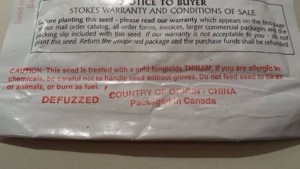
I was sorting through a stash of seeds for the school garden tonight and ran across this packet of tomato seeds.

20140308-212554.jpg

20140308-212928.jpg

Please read the “fine print” in red on the last photo. These seeds are toxic to those with allergies to chemicals, should not be fed to animals or birds and should not be handled without gloves… but it’s okay to plant them in the soil and eat the fruit that comes from them.

Organic standards do not allow these or other chemicals to come in contact with our food at any stage of growing, processing, storage or handling which is one reason to choose organic over conventional food.

Typically, in the US, companies are not required to disclose which chemicals they use in their processing on labels.

I’m not sure why this was labeled the way it was, I’m guessing it’s because it was from Canada (because this is not the norm in the US), but if you saw this “Caution” on the seed you were about to plant with your children, on the fruit you were about to buy in the store or the bread you were about to buy, would you change your mind?

Would you still think the packet of organic seeds that costs 25 cents more, the apples that are 15 cents more or the bread that is 50 cents more is expensive or would your perception of what you are about to purchase change?

The only guarantee we have today, that these and other chemicals aren’t in our food, is to buy Certified Organic.

Be mindful. Be well.
Kate