April 5, 2013

Elderberry – Why you want two

Have you ever heard the phrase, “The best time to plant a tree is five years ago.”? Well, that’s kind of how I feel about Elderberry (even though it’s a shrub).

Elderberry, a native shrub to North America, can be grown in (hardiness) zones 3 – 10 and can be planted in virtually any condition. It grows anywhere from full sun to part shade. They are very adaptable to different soils, but thrive in wet areas (where a lot of others can’t).

American Elder flowers

Their résumé looks pretty good too. If you are looking for a plant to do some work for you or provide you with more than something to look at, they are a very useful shrub. They attract beneficial insects to the garden, their white flowers can be used for tea, and their edible blue-black berries can be used for a quite tasty medicinal elderberry syrup (which is very tempting to pour onto pancakes), can be made into elderberry wine or used for jams and pies.

And , if you’re looking to bring wildlife to your yard, they also attract birds both because of their multistemmed form, where the birds with take cover, and their fruit serves as a bird buffet. Elderberries can get quite large though, ranging from 6 – 12 both high and wide, and they need a friend as a pollinator in order to get fruit so you can’t plant just one, you’ll for sure need two, but if you have the room, plant a few or more that way there will be enough fruit for you to bake, brew and share with both friends and the birds.

Did I mention they have fall color? They are beautiful in the fall as well!

American Elder Fall Color

Elderberry is one of the coolest plants that I don’t have in my yard, but it is definitely at the top of my list to plant this year.
Kate

Photos from University of Minnesota Extension

20130409-091904.jpg

April 4, 2013

Daffodils – More Than Just Another Pretty Face

a-to-z-letters-d


Daffodils, some of the first flowers to appear in the spring, even before the trees leaf out, brighten up dark corners and otherwise still groggy gardens.   They remind me of the sunrise, the centers ranging from yellow to peach to orange with the bright white petals like the rays reaching out.  Even the pure yellow daffodils shine brightly like a the mid-day sun.  But there’s more to daffodils than their pretty face.  They can serve a purpose in your garden as well.

Daffodil

Daffodil

Daffodils are guards in the garden, defending it from both encroaching lawn and from four-legged predators.  When planted densely, daffodils will keep grass out of planting beds, making weeding a much lighter task.

Often times, many of us will plant a fruit tree in the middle of our lawn.  Unfortunately, lawn is not a fruit tree’s friend.  The lawn competes heavily with the trees for water and nutrients in the surface of the soil during the heat of the summer.  Daffodils, on the other hand, are relatively deeply planted bulbs.  They will begin to establish themselves when planted in the fall, put on growth and bloom in early spring.  Then, about the time the trees need water and nutrients, the daffodils begin to die back, reducing their need for water until fall when the tree begins to go dormant and process begins again.

In addition, daffodils help defend fruit trees against predators.  As a member of the onion family, they contain a toxin that deters many animals, including squirrels, deer, gophers and mice from gnawing on the tender bark when planted close to the trunk off fruit trees.  One word of caution, however, although daffodils are in the onion family, they are toxic to humans and should not be ingested!

Other benefits of daffodils are that they are a perennial bulb, therefore only needing to be planted once and will return year after year. They will also gradually reproduce, making them a great bulb for naturalizing under a tree or in a shade or woodland garden.


Naturalized Daffodils

Naturalized Daffodils

One last fun note about daffodils – their faces follow the sun throughout the day.  This is fun to observe both for kids and kids at heart.

Many of the daffodils relatives, in the onion family, will serve the same purpose in the garden.  Allium, the tall blue, white or purple puff-ball on a stick, which resemble fireworks in the sky, will add color and can be found in a variety of heights and sizes.

Allium

Allium


Chives and garlic chives again, provide the same defense against predators and will also attract beneficial insects to the garden, such as teeny-tiny parasitic wasps, plus they have the added bonus of being edible.  And we all know, I’m all about things being edible! 🙂

Chives

Chives


So there you have it. Daffodils (and alliums and chives and garlic chives) are much more than just another pretty face. 😉

Kate

April 3, 2013

“The Coop”

a-to-z-letters-c


If you are going to keep chickens, you must have a coop.  And if you’ve ever done research on coops I’m sure you’ve found that there are about as many coop designs out there as there are people who own chickens.  It can be a very overwhelming experience if you don’t know what the heck a chicken really needs.  Soon, you will realize that most coops are not designed for chickens, they are designed for people.

Selecting a coop

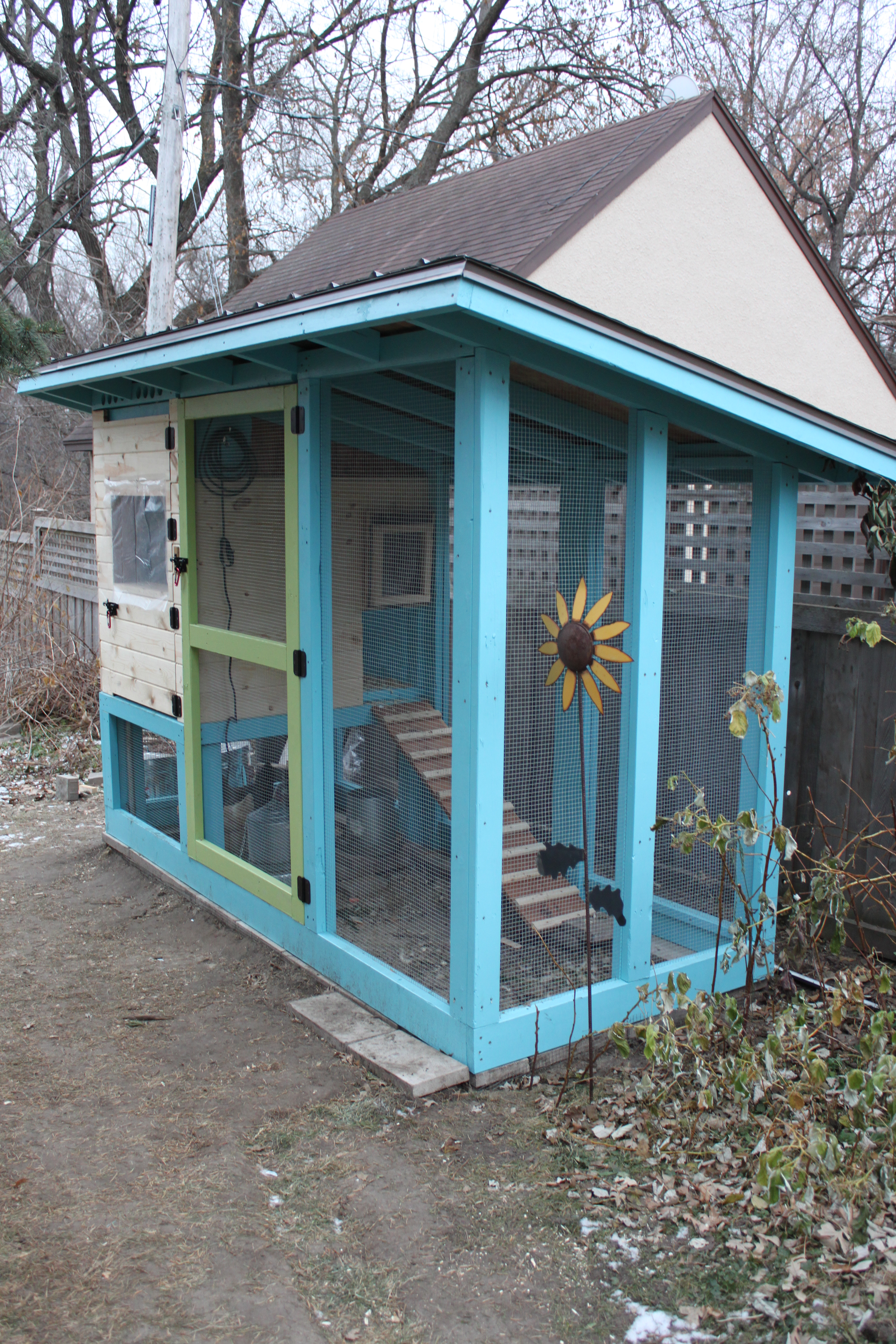
The chickens don’t really care where they live or what it looks like so long as they have the basic necessities; a nesting box, a roosting bar, ample space to move around and protection from predators and the elements.  Beyond that, all the bells and whistles are for the people, and our coop was no different.  After doing some research on the web, skimming about a dozen chicken books and visiting a few coops, I knew there were a few things I wanted in our coop.  I wanted to be able to walk into the space without ducking, bending over or whacking my head.  I wanted it to have easy access for both me and a wheel barrow for cleaning it out.  I wanted it to be predator-proof (we have two dogs, a cat the roams the neighborhood and back-up to a nature center full of wildlife including a pack of coyote).  Also, I didn’t want it to be an eyesore and I wanted it to be a little whimsical as well because, well, chickens don’t exactly strike me as the serious type.  In the end we decided practical ranked higher than whimsy so we selected the Wichita Cabin Coop for our design.  Not exactly whimsical, but I’m opting for paint to get my whimsy.

Wichita Cabin Coop

Wichita Cabin Coop

Selecting the site

When we were selecting a site for the coop we knew we wanted to use the existing fence for added protection from the elements,  I wanted to easily see the coop from the house in case of chicken drama, I didn’t want to travel too far from the house to the coop (especially in the winter), I wanted it out of the path of kid play (I didn’t want the chickens to be traumatized by the soccer balls blasting into the side of the coop or the run) and ideally, it would be close to the veggie garden and compost bin.  The chickens also need some sun, some shade, protection from wind and protection from wetness.

Our coop is sited so that the end of the coop with the run is closest to the house and the nest box end of the coop is farthest from the house so we can see the girls when they are outside.  The coop is visible from our kitchen, the dining room, the sunroom, the master bedroom and the master bathroom.  It is sited on the north side of our fence, which provides shade from the summer sun, but doesn’t protect them from NW winter winds.  Fortunately, we also have a 100-foot high, 15-foot wide spruce tree that is 5  feet from the coop which serves as a wind block.   They get morning sun from the East on the nest box end and late afternoon sun from the West on the run.

Selecting the color

A few years ago we built a shed in the back yard and wanting to conserve and utilize rain water, we put a metal roof on the shed.  We want to add a rain barrel to the chicken coop as well and therefore wanted to have the have a little uniformity with the shed so we chose to use the same roof.  Originally we were going to side the coop in cedar, the same siding as we put on the shed, but were extremely lucky and neighbors offered reclaimed wood for the project so we shifted gears and decided to paint it instead.  Well, that opened up a lot of room to play, only limited by the roof color.  I was excited because now I could add a little whimsy to the coop that I was hoping for.  Originally I was leaning toward a sage green or red, but our son really wanted “blue, the color of the sky”, so we agreed.  I figured, why stop there?  If we’re doing bright blue, why not lime green too?  And perhaps accent with a little tangerine.  Yes, our coop will definitely have color! (And when the snow melts I plan to add a little whimsy as well.)


The Coop (minus the window)

The Coop (minus the windows)

The Materials

Although chickens only cost a couple of dollars to buy, the coops can be downright expensive.  Granted, the smaller you go, the less expensive they are, but even so, if you are to buy a kit, they can still range anywhere from $300 to $3000 and more!   We were lucky.  As I mentioned, the majority of our lumber was given to us by our neighbors, so we had very little cost there.  We used old double hung windows in our shed and I wanted to stick with reclaimed windows again if we could, so we headed to Bauer Brothers Salvage and found a few gems there.  We bought the roofing, the siding, the hardware cloth, 2 gallons of blue paint/primer in one, a quart of the green paint/primer, hinges, screws, misc. hardware, patio stones, wire, conduit and a trenching shovel from Home Depot and Menards.

So that’s our coop, designed for us, with the girls in mind.  We’ve been very happy with the design.  I works well both for us humans and our feathered girls.  When the weather warms up I’ll finish the painting and add some other touches.  I’ll add more photos as the project progresses.

If you want the nitty-gritty details on how and what we did, let me know and I’ll put together a post on that as well.

Kate

April 2, 2013

Blackstrap Molasses Fertilizer

20130402-230852.jpg

Blackstrap Molasses. Strong, dark, sticky. Rich, pungent, earthy. When I think of molasses I usually think Gingersnap Cookies. Oh, how I love gingersnap cookies. Just the thought of them makes my mouth water. Until about a month ago I never really gave it much thought as to what molasses was made of, it was just molasses.

Blame it on the long Minnesota winters, but come late January, early February, after the holidays have passed, I get bored, antsy. I need to do something. And by “do” I mean grow something. You see, by this point the ground outside has been a frozen arctic tundra for 4 or 5 months, spring doesn’t come for another 3 or 4 and it’s too early to start seeds for the garden. So usually about this time of year I set my sights on my “house plants” of which I have about a hundred. And by house plants, I mean plants that I am currently growing in the house, not necessarily house plants as you may normally find.

I love plants. Every kind of plant. I have no prejudices against them unless they are mean to me (burn or poison me), taste bad or don’t mind their manners (invasive), otherwise I can usually find something cool about pretty much every one of them. To give you an idea, my sunroom currently contains: hops, jasmine, bay, spearmint, asparagus, sedum, a lemon tree, a dead lemon tree, a pomegranate, a dead palm, a juvenile avocado tree, 3 or 4 orchids, a really cool pink flowered thing, mother of thousands, begonia, asparagus fern, passion-flower, a couple of pathos, a half-dozen or so Christmas cacti, and a bunch more I don’t recall at the moment.

With all of these plants you would think I would cruise through fertilizer, but you see, that’s the thing I don’t particularly care for chemical fertilizer, so I usually don’t feed them, or I haven’t anyway, until last month. Then when my sights got set on my house plants, I had this nagging in the back of my mind that I need to do something to feed them. That’s when I remembered a conversation with my friend Organic Bob, a soil guru, mentioning that in his organic lawn care business they use compost tea on lawns then “feed” them with molasses. So I wondered, could I use the same stuff for houseplants? I did a little research and found that in addition using it on lawns and organic veggie gardens, sure enough, you can use molasses on houseplants as well. Although it’s best when used in conjunction with another fertilizer, such as compost tea, alfalfa tea or fish emulsion, it can be used alone too.

Molasses is the byproduct from the sugar-making process and is very high in nutrients. Just to give you an idea of how nutrient rich it really is… It contains iron, magnesium phosphorus, potassium, sodium, zinc, cooper, manganese, selenium, thiamine, riboflavin, niacin, pantothenic acid and choline. And, no, I cannot pronounce all of them and I can’t remember them off the top of my head, but the key thing to remember is that molasses is very nutrient rich.

But it gets better: there are different densities of nutrients due to how molasses is made. To get that info, we need to delve into the sugar-making process a little. The sugar-making process is a three-step process using cane juice from sugar canes or beet juice from sugar beets. Basically, they take the cane juice or beet juice and cook it down until sugar crystals form. The sugar crystals are removed, leaving behind all of the nutrients from the sugar cane or sugar beet in the byproduct syrup called molasses. This syrup is boiled a second time, again removing the sugar crystals and leaving behind the nutrients in the syrup. After the third boil what is left is very dark syrup dense with nutrients, known as Blackstrap Molasses.

Unsulphered Blackstrap Molasses is the best choice for use as a fertilizer, partly because it has the most nutrients of the various molasses and partly because it is unsulphered. Unsulphered means it was not processed with sulfur dioxide to keep the sugar cane or sugar beet “fresh” until processed into sugar. But to keep it fresh means it kills microbes and we want to keep microbes because we want to feed the soil. So what we are looking for is microbe and nutrient rich molasses or Unsulphered Blackstrap Molasses.

So I suppose you are wondering if it works. Well, I don’t believe in reading books or info on the internet and just regurgitating information without actually trying things myself to see how it works, so I did just that. At first I experimented with just a few plants. Within days of giving them an initial feeding they put on new growth, started putting out new buds and started perking up. I’ve now fed nearly all of my plants with molasses and while I realize the longer days and stronger sun are helping things along, every one of them has put on new growth, many have blossoms (my jasmine plant is in full bloom) and their overall health has improved, so I would have to say yes, it works.

I realize it’s not fair to talk about it without sharing the info, so here’s the recipe I used:

Blackstrap Molasses Fertilizer

2 teaspoons unsulphered blackstrap molasses

1 liter water

Mix well and feed plants once a month. That’s it!

If you are interested in recipes combining molasses with some other fertilizers these are good sources to check out:

Fertilizing Houseplants with Blackstrap Molasses

Molasses and Alfalfa Tea Mixture

So there you have it. I guess molasses isn’t just for gingersnap cookies anymore! I can’t wait to try it on my seedlings and in my garden this summer.

Kate