Archive for ‘Veggie Garden’

October 24, 2011

Fall Clean-up

Fall clean-up.  We all hear the phrase, but what exactly does it mean?

Fall clean-up means removing any dead, diseased or dying material from your gardens at the end of the growing season.

Where to start?  Wherever you’d like.  I typically start at one end of my yard and work my way around, armed with gloves, pruners, clippers, loppers, a large garbage can and bags.

What am I looking for?  To start off with, anything that’s “done”.

Annuals are pretty obvious.  You can take one look at them and say “yep, they’re done”.   Annuals are typically just as dramatic when they’re done as when they’re at their peak.  In other words – pretty darned ugly.  Yank ’em.

Perennials on the other hand, aren’t quite so cut and dried (so to speak).  Obviously if you have ornamental grasses, Asters, etc. that are at peak right now, don’t touch them!  As for perennials that have already passed their peak, start looking for diseased material.  If the plants are “done” and have a disease such as powdery mildew (the white frosty looking film) on their leaves or stems, cut them “way back” (typically to 3-4 inches high) then DISPOSE of the diseased material.  And by dispose, I mean DO NOT put this stuff in your compost bin/pile!  If you leave it and let the leaves eventually fall to the ground powdery mildew spores will get into the soil and increase your chances of having problems again next year. The same applies to compost.  You don’t want those spores in your compost!  Instead, put the diseased material in a tightly sealed garbage bag and toss it in the garbage or burn the plant material in a fire pit (assuming no burning restrictions in your area).

So what if you have perennials that are “done” but still look healthy?  In this case the decision is yours.  Since three-quarters of our year is winter (okay, slight exaggeration..) I like to leave as much as possible for winter interest and food for the birds.  Good examples of this are Black Eyed Susan, Cone Flower, Bee Balm and definitely Ornamental Grasses!  The more texture you can leave in your garden to look out onto during those blustery winter months the better.

What if its none of the above?  Not peaking, not dead, not diseased, but just “done”?  Then what?  In this case cut it back. If it’s not going to add anything to your winter landscape then it’s only going to become more to clean up in the spring.

On to the veggie garden.

When it comes to diseased plants the same rule applies in the veggie garden as it does in the flower garden.  Diseased plants = trash or burn.

Warm season crops (tomatoes, peppers, etc.) have done about all they are going to do. I know, it’s sad, but it’s time for them to go.  Pull them and toss them.

Cool season crops on the other hand might still be doing well.  If you have cool season crops that are still producing, by all means, leave them!

One good example of this is Brussel Sprouts.  Brussel sprouts like the cool weather and actually taste better when they’ve been nipped by frost 6-8 times.  They can even withstand mild winter temps, even if buried in snow!  The bonus?  Instead of tasting bitter like they often can, the frost/cold draws the sugars out and they will be super tasty!  How can you tell if they have been nipped by frost and are “ready to eat”?  The outer edges of the leaves will have a purple tinge to them.

Pull any other crops that are not perennials (asparagus, strawberries, etc.) and not producing and clean up all leaf litter to minimize future disease.

That’s about it.  Once it’s clean, your garden is going to look a little bare, at least until the snow flies!

Kate

October 10, 2011

Growing Garlic?

If you’re a garlic lover like me, what can be more fun than growing your own?  Actually, I could say that about a lot of things that I grow because, well, I just find it fun to be able to grow things, especially if they’re a little different.  For example the ginger (root) I’ve been growing in a pot in my sun room for the past few years.  Why?  Simply because I can!

Back to garlic.  Garlic is a bulb and much like flowering bulbs such as tulips, daffodils, etc., garlic needs to be planted in the fall to be harvested the following summer.  Why fall?  Certain bulbs need a cold treatment the best development of the roots and the bulb. Garlic is one of those bulbs.

The ideal planting time for garlic is about two weeks after the first hard frost (32 degrees or less) or sometime between September 15 and October 15th or when the soil temperature is around 60 degrees F.  Clear as mud, right?  (That’s now just in case you didn’t follow all of that.)

So how do you grow it?  Garlic can be grown in beds with rows 30 inches apart on center and 6 inch spacing between plants.  The day of or a day or two before planting, separate the individual cloves from the bulb (a.k.a. head) of garlic. When separating the cloves make sure a small piece of the basal plate (the little flat part at the base of the bulb where the roots grow) is attached to each clove or it won’t root.  When planting day arrives, plant each clove 2 – 3 inches below the surface of the soil with the pointed part facing up.  (If you accidentally plant them upside down they will still grow, but will have an odd shape when you harvest them.)

A few weeks after planting, cover the rows with 3 – 4 inches of straw mulch (seed-free!) to prevent drastic soil temperature changes.  Since Garlic needs a cold treatment, the roots and shoots can tolerate freezing conditions as long as they are mulched to minimize excessive fluctuation in soil temperatures in the winter and early spring.  (Mulch can be removed in the spring after the threat of hard freezes is over, around April 15th.)

When buying bulbs, keep in mind you don’t want to plant the bulbs you buy in your local grocery store because they are typically grown in much warmer climates and won’t be hardy in our climate.  Instead, it’s best to buy local or cold hardy Garlic bulbs.  I bought mine at EGG|PLANT Urban Farm Supply in St. Paul this year, but you should be able to pick them up at other garden supply stores or order them online. The Growing Garlic in Minnesota piece (below) has a nice list of Garlic sources as well.

Garlic

Garlic

As far as what kind to buy, there are many types and varieties of Garlic, but they all fall into one of two basic varieties: hard neck and soft neck.  The main difference is that hard neck produce flowers (a.k.a. scapes) and bulbils (baby bulbs) while soft neck do not produce flowers.  If you like garlic scapes and plan on cooking with them or using them in arrangements, you will need to buy hard neck varieties (soft neck will not produce minimal scapes if any).  Beyond that, there are more types and varieties varying in flavor, temperature (mild to hot), etc.  As for me, I’ll be planting three hard neck varieties: Chesnok Red, Georgia Crystal and German Extra Hardy.

If you decide to grow Garlic and want more detailed information, download the pdf of Growing Garlic in Minnesota from the University of Minnesota.  This is filled with detailed info on soils, water, weather, insects, diseases, pretty much anything that might impact garlic growth.

Growing Garlic?  Feel free to share your story!

Kate

October 3, 2011

Volunteers – Take ’em or Leave ’em?

Walnuts and Pears… In my yard you will find two pear trees and three walnut trees growing.  I have to be honest though, I can’t take credit for planting the walnut trees, the squirrels did it.  Well, actually they buried the walnuts, saving them for a rainy day, but instead they apparently forgot about them, it rained and walnut trees were born.   Therefore, the walnut trees  are technically volunteers, but since we thought the squirrels did a nice job of placing them we let them be.

I’m kind of a sucker for growing things that way.  I LOVE volunteer plants.  As much as I love growing plants from seed propagating, grafting and the like, there’s nothing quite as cool as nature placing something for you.  As humans, we often times try to design things in an effort to make the setting look “natural”.  What better way to do that than to just leave it?  If it grew there on its own, there’s no guessing as to whether the growing conditions are right in that location.  If they weren’t, it wouldn’t have started growing to begin with.

I understand that not all volunteers come up in the best spot and if that’s the case I’d say remove it.  If it’s in a bad spot chances are it won’t make it in the long run anyway. I had a volunteer trumpet vine growing in my yard that I left for a while.  I was going to train it into a standard so I would look like a dwarf tree. I had also started to braid the trunk thinking it would be really cool down the road.  The problem is, the trumpet vine was growing right in the middle of a natural pathway through the back yard.  At first I tried to shift the path around the plant, then after watching others awkwardly duck around it and try not to poke an eye out on the thing I decided it was time to get rid of it. Which, if you’ve ever tried to get rid of a trumpet vine, you know that’s no small feat!  So I know, not all volunteers make sense to keep.

I have a number of other volunteer plants growing in my yard right now too.  In addition to the walnut trees, there is a volunteer oak tree in the front garden.  It’s all of maybe 10 inches high after two years, but it’s doing well and I intend to leave it there.  Long term it will overshadow the plants currently in that location, but that won’t be for many, many years, so I’ll worry about that when the time comes.

Then there’s the volunteer elm tree.  I struggle with that one.  I discovered it during the timeframe that I wasn’t feeling well and I really didn’t want to keep it, but I literally didn’t have the energy to dig it out at the time.  I think it knew that.  It completely took advantage of the situation and made itself right at home in the middle of one of my perennial beds in the back.  It’s now close to twice my height so I’m pretty sure it thinks it’s staying for good but little does it know its days are numbered.

I can pretty much count on having volunteer tomatoes come up in my veggie garden or some other random place in my yard every year too.  Most of the time I’ll pull them (especially to try to keep a good crop rotation in the garden) but occasionally if I’m feeling nice (or like I just want more tomato plants) I’ll leave them be.

This year, I had the most odd volunteer ever.  I have a plant growing out of the side of my compost bin. (I obviously didn’t do a thorough job of turning my compost last year!)  At first I was excited, I thought it was one of the cool pumpkins I bought last year.  No such luck.  When the fruit began to form it didn’t look like a pumpkin at all: it was too oblong and had very shallow grooves.  Then I thought maybe it was one of those tasty cantaloupe from last year.  Again… no luck.  Turns out it’s just squash.  I wish I could say I’m a huge squash fan, but I’m not.  I like it, but don’t LOVE it.  I’ve even found recipes in the past that I really enjoy, but it’s still squash.  The problem is, I honestly don’t have a clue what kind of squash is growing out there, which means I also don’t know what to do with it and I have a lot of it!

My guess is, whatever it was last year, the seed germinated and reverted back to the genes from its parents… OR it’s an entirely new variety, in which case I’d better get this puppy to the market and make millions!

There have to be squash lovers out there somewhere, right?

Squash anyone?

Kate

August 12, 2011

Mother of a Butterfly

For the past few weeks we’ve been caring for another life our house.

It all started on Monday a few weeks ago.  My son brought home his harvest from his children’s garden at the Arboretum.  As he was showing me all the vegetables and flowers he’d harvested, he spotted a caterpillar.  It was crawling on one piece of the vast amounts of dill he’d brought home.  How he spotted it, I’ll never know.

We decided to keep it.  We transferred the caterpillar, along with a few pieces of dill, into a little cup.  He covered the cup with plastic and poked a few air holes in it.

Caterpillar in a cup - for perspective

We continued feeding it fresh dill and cleaning its home daily (we learned caterpillars poop a lot) and literally watched it grow before our eyes.

Caterpillar, dill (and poop)

Having never kept a caterpillar for more than a couple of days, we found the entire transformation absolutely fascinating.  At first it was pretty small and didn’t have a lot of color, but after shedding a couple of layers of skin its color became more and more vivid.  It’s black body had cream-colored spots and bright green stripes.

After less than a week the caterpillar outgrew its little cup so we transferred it to a butterfly/bug box my son had gotten when he was younger.  In its new home the caterpillar continued to dine on its daily buffet of fresh dill until one day, about a week ago, it just stopped.  It stopped eating, it stopped moving.  It scrunched itself up and only moved if we (unintentionally) startled it and at that, it would only flinch.

Preparing to cocoon

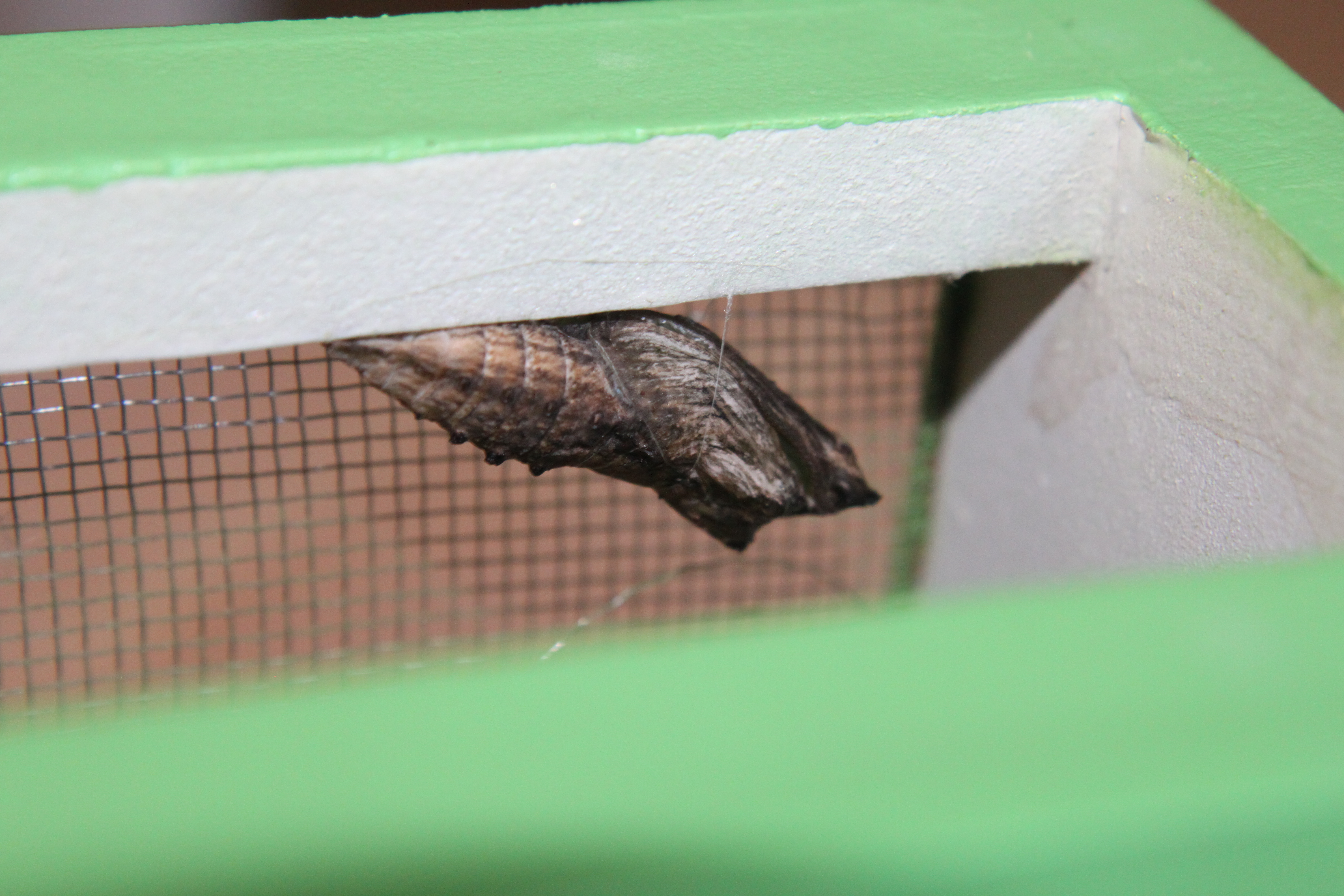
After a day or so, it formed its cocoon/chrysalis and there it stayed, attached to the upper part of the butterfly box, for at least another week.

Cocoon/chrysalis

This morning, as I was reaching for a cup of coffee, my son screamed. I jumped, my coffee starting doing acrobatics in the air and amazingly enough, every drop landed back in my cup.  When I turned to see what he was screaming about, he was pointing to the butterfly box, shouting “Mom, look!  Look!  I knew it!  I knew it would be a butterfly!”  And so it was.  Black, light spots, trademark tail.  We’d guessed right.  Our caterpillar was a swallowtail.  At first he was disappointed. “Mom, it doesn’t have the blue like we thought it would.”  We’d spent a little time, looking at pictures of swallowtail caterpillars and butterflies on the web, so he had in his mind what it would look like.  It wasn’t there, yet.  I reminded him that it takes a little while for the color to fully develop on their wings.

Newly emerged Black Swallowtail butterfly

After admiring our butterfly in the kitchen for a little bit, we decided it was time to release “him” (we found out later “he” was actually a “she).  So, outside we went, searching for a good spot.  We tried a little zinnia my son had grown from seed but it seemed a little too small.  We then contemplated between milkweed and a few other flowers.  At last my son decided on the phlox.  We gently transferred him, then headed inside to finish “getting ready”.

Black Swallowtail on phlox

About an hour later I thought I’d check up on our butterfly and see if he’d flown away yet.  I peeked out the window but couldn’t see him.  I decided to go out and look. I found him, not on the phlox, but on the ground fluttering around.  My heart sunk.  Oh, no!  I’d seen the neighbors cat in our yard earlier, I was fearing our butterfly had been used as a kitty toy.  I gently eased him onto my finger. He appeared to be untouched.  I tried to transfer him onto some plants but he didn’t want to go. He kept turning around and walking up my finger and onto my hand.  Finally, I transferred him.  This time to one of the milkweed leaves.  Periodically I would look out the window and see him, still clinging to the milkweed.

Black Swallowtail on milkweed

Later, I peeked out again and didn’t see him.  Again, I went out to find him on the ground. Crap! Did we do something wrong?  Did his wings not grow properly?  What happened?  I eased him onto my finger again, checking him over.  Everything looked okay.  The body of the butterfly was shaking, it had been all morning. My son had noticed the shaking early in the morning and asked me why it was doing that.  I had no idea, I’d assumed it was like a colt standing on shaky legs for the first time.  Maybe he needed nectar? A little sugar to give him the energy to fly.  I set him on the phlox again where his tongue could easily reach for food.  He didn’t eat.

Black Swallowtail on phlox... again

I got distracted (as I often do).  I saw a bee in another phlox and since I just happened to have my camera on me, I started taking pictures.  When I turned back, the butterfly was gone.  I searched the ground fearing I’d bumped him and knocked him off the flower inadvertently.  He was nowhere to be found.  That’s good, right? He was gone. He must have flown away.  Good for him.  Sort of.  I have to admit, as silly as it sounds, I was a little disappointed that I didn’t get to see him take off.  It felt kind of like your child leaving without saying goodbye. I know, I know… It’s just a butterfly.  But still.

Since the weather is so beautiful this week, I’ve been trying to take advantage of it and get outside as much as possible.  I decided to have my lunch outside today (in hopes I might see our butterfly again).  It just so happened that as I was just about to sit down, out of the corner of my eye, I saw fluttering!  I glanced up to see our butterfly – black with beautiful blue and splashes of orange. He fluttered by, sat on my son’s zinnia just for a minute, flapped his wings, then was gone.

That’s what I needed.  I just wanted to know that he was okay.  I smiled.  A proud mom… of a butterfly.

Kate