Archive for ‘Seed Starting’

February 2, 2012

A Confession and The Beginning of the Garlic Experiment

I have a confession to make.  Remember last fall when I wrote Growing Garlic? and told you the time was right for planting, how to go about planting it, so on and so forth?  Well, guess who didn’t get out there and plant her garlic before the ground froze?  Yep, you guessed it.  Me.

So what’s a girl to do about this?  Well, let me tell you.  Tossing the garlic heads was never an option.  It goes against my grain.  I had to do something with it.  Given my background in gardening, landscaping and horticulture, I know that certain bulbs, flowering and edible, need a cold spell to get the bulbs to plump up for the next season.  Garlic is one of them.  But, I also know that if circumstances don’t cooperate sometimes you can fool Mother Nature and recreate that cold spell with a refrigerator (cold conditioning).  So that’s my plan which I’ll be executing shortly and you can all ride along with me on what I will call the “Garlic Experiment”.
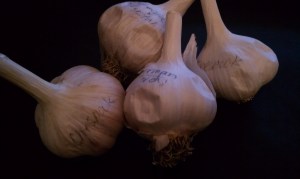
Sad garlic

What I can tell you right now is that this will definitely be an experiment.  Some of the bulbs are already fading, they are no longer firm to the touch which means they’re drying out (not a good way to start off) but I’ll see how bad they are when I break open the heads and take off the individual cloves, at that point I’ll provide pictures and the play-by-play.

But before I begin the experiment I had to do a little research.  I already knew that garlic needs a cold treatment to get the bulbs to form, but what I didn’t know was how long they need to be cold to give the bulbs enough time to form.  Since we typically don’t have a hard time finding cold weather for growing garlic in Minnesota, I had to start doing a little research on how southern gardeners grow garlic.  So far my research has shown that garlic needs anywhere from 2 weeks to 8 weeks of cold to produce a bulb.   Well, super!  That’s pretty specific!  That’s a lot like waiting for the furnace repair man to come and they say they’ll be arrive on Thursday, sometime between 8am and 5pm.  Thanks for narrowing that down for me!  (Obviously I have a little more work to do.)  If you remember from last fall, I have 3 kinds of garlic .  Tonight I’m going to do a little more research and see if I can find specific information on what each of them prefers and then go from there.

Until then, please accept my apology for not planting when I advised you to.  Life happened, so it didn’t get done.  At least now we have an excuse for an experiment!  And boy do I love experimenting with plants!

Kate

May 27, 2011

Planting time!

Memorial weekend, garden calendar, garden notebook.  What do all of these things have in common?  It’s time to plant!

By now we should be in the clear as far as frosty nights are concerned, but the other key factor to seed germination and plant growth is warm soil.  Each seed needs certain conditions to grow, warm season crops and tender crops typically need the soil temp to be 60 – 85 degrees in order to germinate whereas cool season crops only need it to be around 40 degrees.  Granted we’ve had a crazy spring, (although growing up in Minnesota, I’m not really sure what a “normal” spring would look like!) but the soil temperatures over the last week or so have been hovering in the low to mid 60s in Central Minnesota, so it’s basically a green light to plant.  As the soil continues to warm, the seeds will germinate and the plants will begin to grow.

One thing to keep in mind if you’re doing container gardening is that the soil in the containers warms and cools more drastically than the soil in the ground.  What this means is that they truly benefit from a warm, sunny day now because the soil will warm faster, likewise later in the summer they will continue to warm faster, which is why some plants tend to wilt in pots.  The soil in containers will  also cool significantly faster as well.  This is part of the reason why container gardens typically need more attention than plants in the ground, but that’s another subject all together.

So, now’s the time to pop those warm season crops, such as tomatoes, peppers, eggplants, etc. in the ground.    If you haven’t started your own seeds earlier in the season, buy seedlings or more mature plants from local plant sales or garden centers.  Warm season crops have a long growing period.  If you plant these from seed now, they won’t have enough time to grow and produce fruit before frost in the fall.

Now is also a good time to plant the tender crops like cucumbers, pumpkins, melons and squash.  These, unlike warm season crops can be planted by seed now.  To help them germinate more quickly, you can cover them with hot caps (a.k.a. Hot Kaps, Hotkaps) to help warm the soil and get them to germinate faster.  Remove the cap when they are  growing vigorously.

If you haven’t already done so, you can also plant: beans (bush, pole, dry, lima), beets, broccoli, brussel sprouts, cabbage, carrots, cauliflower, celery, radishes, kohlrabi, lettuce (leaf and head), parsley, potatoes and sweet corn.

I wish you a happy holiday weekend and happy planting!

Kate

April 23, 2011

History, gardening and experiments

History was never my strong suit while in high school.  In fact, I remember many classes struggling to keep my eyelids propped open.  I never understood the point other than learning from it so we don’t make the same mistakes twice.  But really…why were we studying this?  How would it ever apply in life?

It wasn’t until I was in college and selected a major that I started to get intrigued by history.   I was a German major my first go around, so I was learning all about German history and was actually interested. Then I decided to study abroad, in Austria.  Naturally my next round of history classes were about Austria.  I found this equally interesting because I would be going there.  I could apply it to something.

Now, I don’t proclaim to have memorized all the details.  I’m more of a big picture person in pretty much every facet of my life.  I couldn’t repeat detail for detail what happened, but I can tell you the overall concept and the impact it made.

Fast forward about 15 years and I went back to school again focusing on Landscaping and Horticulture.  It seemed like a natural fit for me.  I’ve always enjoyed gardening.  I grew up helping in the veggie garden, planting flowers and even “propagating” Hens and Chicks when I was quite young.  I remember being 7 or 8 years old and realizing that if I gently removed the “chicks” from the “hens” and nestled them into open soil, they would begin to grow quite well there.  It wasn’t long before we had a nice crop of them just outside the back door!

I also vividly remember growing my green bean in a cup in elementary school and trying to grow avocados from the pit on numerous occasions.  The excitement I got from this was ridiculous.

Ever since I’ve had a place of my own, I’ve had far more “house plants” (plants I grow that happen to be in the house) than most normal people.  I’m constantly trying to grow something new, just to see if I can. In fact, when I moved out of my apartment (which I shared with a roommate) to our first home, there were 3 pick-up bed loads of plants to move.

So you see, I think I’ve been a plant geek pretty much all my life.

How does all of this tie into history?  Well, somewhere around the time that I was thinking about going back to school I went to visit my mom in Washington DC.  She took me to Thomas Jefferson’s Monticello, plantation and gardens. If you ever get the opportunity – go there! It’s by far one of my favorite places. I fell in love.  I think that’s when it hit me that my fascination with plants isn’t so odd, or, if it is, at least I’m in good company.  Learning about Jefferson’s gardens, micro-climates he created to grow olive trees and grapes that never should have survived in Virginia was so inspiring. Again, history had a place for me.

Thanks to Jefferson, I continue to try grow new things all the time.  I’ve now got my own grapes, pears, apples and hardy kiwi not to mention the veggie garden and perennials.  I’m never afraid to try growing something new, that’s how I learn.  Besides, what’s the worst thing that could happen?

My next experiments are going to be an olive tree and date palm (grown from seed) and I recently heard there’s a banana tree hardy to our area.  I just might have to try that too!

Happy experimenting!

Kate

April 18, 2011

Sometimes it snows in April… but the seeds keep growing

It’s April 18th, and we have a Winter Storm Watch.  Really?  Seriously?!?  Unfortunately, yes.  They’re predicting 6 inches of snow or more.

“This is a problem” my 6-year old son said, “because it’s Spring…. and it’s a Winter Storm Watch…”  I concur.  This is a problem.  Mostly for my spirit, but some plants and flowers are getting nipped as well.  Hopefully the snow over this past weekend and the weather we’re going to have over the next few days won’t set us back too much. I really hope the forecast is wrong.

I started my spring clean-up when it was in the 60s a or so week ago.  This weekend I had hoped to do more, including getting my cool crops planted in my veggie garden.  Unfortunately, the cold dampened my spirits a little and I didn’t get out there.  Oh, well. That’s what spring in Minnesota is like.  Next week I’m forecasting 80.

Regardless of the weather outside, if you’ve already planted seeds inside, they should be clipping along pretty well.  If you’re growing under plant lights make sure to keep the lights low (not touching the plants,  but close to them) to prevent them from getting leggy.  I usually keep a fan running too. It keeps the air circulating which helps strengthen the seedlings (mimicking wind) and also prevents damping-off.  If you’re not familiar with this term, damping-off is when one of a variety of fungi infect the seed or seedling, sometimes preventing germination, or after the seed has sprouted, it weakens the plant at the point where the plant touches the soil which eventually causes the plant to rot and fall over.  If this happens to you, try not to get too discouraged.  It happens.

Let’s take a step back and look at the big picture: the life cycle of plants.  A plant’s goal in life is to reproduce.  It’s that simple.  The seed germinates, the plant grows, produces flowers to entice pollination in order to produce fruit/seeds.

Every type of seed needs certain conditions to germinate.  When we start seedlings inside we add heat mats, plant lights, fans, etc. to recreate the perfect environment for germination and growth.  However, we need to keep in mind that the reason plants produce so many seeds is because the plants “know” that not every seed is going to germinate, and of the seeds that germinate, not all of them will survive and of those that survive, not all of them will live long enough, or have the right conditions to produce more fruit and more seeds (reproduce).  Since seeds are the future generation of the plant, and there are many things that could go wrong along the way, plants will typically produce a lot of seeds.  It’s kind of like plant reproduction insurance.

What this means is not every seed you sow will germinate.  Some of your seedlings may die.  Some of your plants may die due to weather or animal damage.  The strong plants will survive and produce fruit.  So, if you happen to lose some along the way, hard as it may be, do not get discouraged. This is all a part of the larger plan.  Things happen, nurture what you can and let the rest be.

Now where did I put that snow shovel?

Kate