Archive for ‘Organic Gardening’

February 2, 2012

A Confession and The Beginning of the Garlic Experiment

I have a confession to make.  Remember last fall when I wrote Growing Garlic? and told you the time was right for planting, how to go about planting it, so on and so forth?  Well, guess who didn’t get out there and plant her garlic before the ground froze?  Yep, you guessed it.  Me.

So what’s a girl to do about this?  Well, let me tell you.  Tossing the garlic heads was never an option.  It goes against my grain.  I had to do something with it.  Given my background in gardening, landscaping and horticulture, I know that certain bulbs, flowering and edible, need a cold spell to get the bulbs to plump up for the next season.  Garlic is one of them.  But, I also know that if circumstances don’t cooperate sometimes you can fool Mother Nature and recreate that cold spell with a refrigerator (cold conditioning).  So that’s my plan which I’ll be executing shortly and you can all ride along with me on what I will call the “Garlic Experiment”.

Sad garlic

What I can tell you right now is that this will definitely be an experiment.  Some of the bulbs are already fading, they are no longer firm to the touch which means they’re drying out (not a good way to start off) but I’ll see how bad they are when I break open the heads and take off the individual cloves, at that point I’ll provide pictures and the play-by-play.

But before I begin the experiment I had to do a little research.  I already knew that garlic needs a cold treatment to get the bulbs to form, but what I didn’t know was how long they need to be cold to give the bulbs enough time to form.  Since we typically don’t have a hard time finding cold weather for growing garlic in Minnesota, I had to start doing a little research on how southern gardeners grow garlic.  So far my research has shown that garlic needs anywhere from 2 weeks to 8 weeks of cold to produce a bulb.   Well, super!  That’s pretty specific!  That’s a lot like waiting for the furnace repair man to come and they say they’ll be arrive on Thursday, sometime between 8am and 5pm.  Thanks for narrowing that down for me!  (Obviously I have a little more work to do.)  If you remember from last fall, I have 3 kinds of garlic .  Tonight I’m going to do a little more research and see if I can find specific information on what each of them prefers and then go from there.

Until then, please accept my apology for not planting when I advised you to.  Life happened, so it didn’t get done.  At least now we have an excuse for an experiment!  And boy do I love experimenting with plants!

Kate

January 17, 2012

Ch-ch-ch-ch-changes

A friend once told me I’ve had more major career changes than anyone she knows.  Well, guess what?  Here we go again!

After giving it a lot of thought and weighing the options, I’ve decided to make yet another change in my career path and venture out on my own. I’ve decided there’s really no better time than the present to take a chance on me.

Over the past couple of weeks, two people I know have passed away, and their departure has made an impact on me.  Although I wasn’t extremely close to either one of them, they always had presence in my life whether they knew it or not. It’s always hard when someone dies, regardless of how well you knew them, at least that’s the case for me.  I always question, Why? Why them?  Why now? In this case, both of the men who passed away left something behind.  Something huge.  They made an impact on all the lives they touched, and are leaving behind a legacy.

That started me thinking, what would happen if tomorrow was “my day”? All too often I think “some day” I’d like to do this or “some day” I’d like to do that.  These deaths reminded me that if I keep waiting for “some day” it might not happen.  That’s when I realized that I need to make a change.  I can’t keep waiting for “some day”.  Although I enjoy some of the things I do at my current part-time job, it’s not really “me”.  It’s not fulfilling.  And for something to be “me”, I need to feel like I’m making a difference.

So after mulling it over a while, I decided that I need to make a change and do something that makes me feel good, because as Ralph Waldo Emerson once said, “Life is a journey, not a destination.” Or my little twist is that the life is about the journey, not the destination.  We all come to the same destination, so we need to make sure we’re making the most of our journey.

I have a few days left to wrap up some of my projects with my other job and then I’ll be on my way to my new adventure.

My plan right now is to do consulting in variety of capacities, all tied into landscaping, gardening, sustainability, health and well-being.  I’ll be doing some writing, some marketing, some designing, some creating, some selling and possibly even some teaching.  Sounds like a lot, I know, but they are all surrounding a subject I love.  And if I love what I’m doing, I’ll have fun doing it.  Besides, if there’s one thing I’ve learned about myself over the years it is that I hate to be bored and having many irons in the fire makes me happy.  So off I go, making more changes.  Traveling on a path unknown, but excited about the possibilities ahead.

By the way, remember a while ago when I mentioned that I was on a quest to find my inner spark?  Trying to find that girl who isn’t afraid to chase her dreams?  Guess what?  I found her!

Kate

October 28, 2011

Selecting and Planting Bulbs

Fall is flying by, but if you’re thinking it’s too late to plant, it’s not!  As long as the ground isn’t frozen you can keep planting.  In fact, fall is the time to plant spring blooming bulbs.

There are a few ways to plant them: individually, clumps, mass plantings or naturalizing.

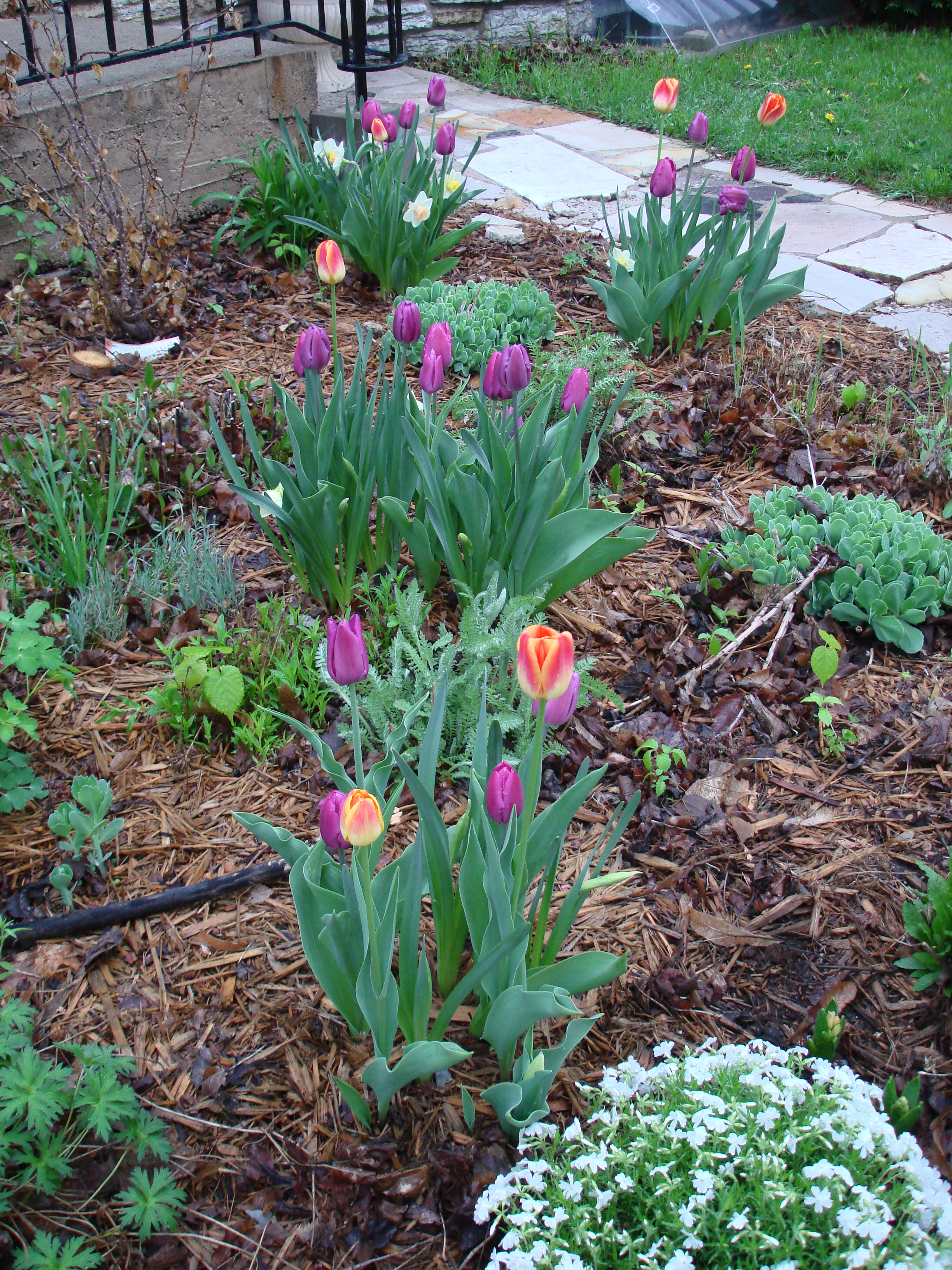
Clumps of Tulips

Clumps of Tulips & Daffodils (shown with Phlox)

But, before we go there, let’s talk about bulbs.  First, I’m going to use “bulb” in loose terms.  There are actually 4 different types of bulbs (tubers, corms, true bulbs and rhizomes).  I won’t go into too much detail here, but they each have different growth habits and needs, which is why you might notice that not all bulbs behave the same way.  Some get better over time, some decline.  It’s in their nature.

There are many different sizes and varieties of bulbs.  When shopping for bulbs, you want to make sure you buy the biggest, healthy bulbs.  First, make sure the bulb is fresh.  Much like a good onion or head of garlic, you want the bulb to look fresh, be firm to the touch and the bulb’s natural paper (tunic/tunicate) should still be on the bulb and be tight.  Also check basal plate (the flat spot at the bottom), it should be firm, not soft.  If the bulb looks dry, has mold, has bruises, insect damage or the paper is gone, don’t buy it!  It won’t produce a good bloom in the spring.

Once you’ve selected your bulbs, be it tulips, daffodils, hyacinth, grape hyacinth, crocus, squill or scilla (the list goes on).  Take them home and decide where you’re going to plant them (if you didn’t have a location in mind already).  Most bulbs are sun-loving, but don’t let that scare you or limit where you plant them.  Keep in mind, bulbs bloom before most trees and shrubs have leafed out, so you can plant bulbs in an area that is typically a shade garden (assuming they are deciduous trees and shrubs and not evergreens).

Once you have selected a site, decide on a planting style.  Many of us grew up seeing individual rows of tulips planted across the front of a house.  While pretty, I find bulbs to be far more stunning and make much more of an impact when planted in clumps, waves moving in and out of other plants or in mass.  In general, bulbs are relatively inexpensive so it doesn’t cost a ton of money to make a big statement in the spring.

Mass Planting of Tulips

Mass Planting of Tulips

Now, maybe you’re thinking, “Are you kidding me? I’m not going to plant a lot, they are such a pain to plant!”  That used to be the case when all the only option was a garden trowel, but now there are tons of bulb planting tools available to make the job easier: bulb planters, bulb trowels, bulb (hand) augers, bulb augers for drills, pick axes, you name it.  However, unless you have really hard soil, want to plant each bulb individually for old times sake or want to have them spaced a specific distance away from each other for a mass planting, I think it’s easier to just grab a shovel and dig a hole (or a trench as the case may be).

If you’re not sure how deep to dig the hole, the rule of them is to plant bulbs 2 – 3 times deeper than their width, for example if you’re planting a bulb that is 2 inches across, you would dig a hole 6 inches deep and wide enough to fit the number of bulbs you want to plant plus room between each one so they don’t touch each other.  Plan on an odd number of bulbs in each hole because odd numbers are most appealing to the eye.  And as far as quantity goes, I would recommend 9 – 11 bulbs to achieve the most full, natural looking clump for large bulbs (tulips and daffodils) and more for smaller bulbs/corms.

If you’re thinking about naturalizing bulbs, there are a few things to keep in mind.  Some are definitely better than others for naturalizing because they will naturally multiply over time (daffodils, crocus, grape hyacinth, narcissus, squill, lily of the valley).  Some of bulbs come to the surface and will need to be replanted every few years (grape hyacinth for example) because they continually “use up” the original bulb/corm and grow baby bulbs/cormals above the original bulb and then some bulbs will sink – yes, sink… their roots, called contractile roots, naturally pull them deeper and deeper into the soil each year (as with crocus).  Others (most tulips) are sterile, in other words they won’t reproduce and will need to be replanted each year, therefore not making good naturalizing bulbs.  The exception would be “species tulips”, which are typically smaller.

Mass Planting of Tulips II

Mass Planting of Tulips - MN Landscape Arboretum

Back to planting… Once the hole is dug, mix a little bone meal (to feed the bulbs) into the soil in the base of the hole, then place the bulbs in the hole.  When placing the bulbs there is typically a flat or flat-ish side (called the basal plate) this is the end that you will find dried roots.  The other end (top) is typically pointed.  Place the bulb pointed side up and make sure there is soil between the bulbs so the bulbs are not touching or they will rot.  Once placed, cover with soil and water well.

If you like to mix bulbs, for example daffodils and tulips in the same hole, not a problem.  “But wait!” you say, “My tulip bulbs are bigger than my daffodil bulbs.  How deep do I dig my hole?”  Here’s the trick.  Did the hole deep enough for your tulips, plant your tulips as explained above, then put a shallow layer of soil in to the hole (an inch or so) again, so the bulbs don’t touch, then plant your daffodil bulbs.  “But what if I plant one right on top of the other without knowing it?” Not to worry, plants are pretty smart.  They’ll work their way around the upper bulbs and make their way to the surface just fine.

Squirrel problems? I’ve heard a lot of people complain about squirrels “un-doing” all their hard work.  Nothing is more frustrating than throwing soil on your last hole, dusting the dirt off of yourself, only to look over and see the squirrels have already relocated your bulbs!  There are a couple of tricks when it comes to squirrels.  Typically squirrels are not a fan of daffodils because daffodils are in the onion family… so…. if you plant daffodils above your tulips there is far less chance of them digging them up.  Another method of protection is to add a piece of chicken wire above the bulbs between layers of soil to prevent them from digging.  Again, the plants will find their way through and the squirrels will most likely be frustrated and move on.

So there you have it… bulbs 101.  I expect to see pictures in the spring! 🙂

Kate
October 24, 2011

Fall Clean-up

Fall clean-up.  We all hear the phrase, but what exactly does it mean?

Fall clean-up means removing any dead, diseased or dying material from your gardens at the end of the growing season.

Where to start?  Wherever you’d like.  I typically start at one end of my yard and work my way around, armed with gloves, pruners, clippers, loppers, a large garbage can and bags.

What am I looking for?  To start off with, anything that’s “done”.

Annuals are pretty obvious.  You can take one look at them and say “yep, they’re done”.   Annuals are typically just as dramatic when they’re done as when they’re at their peak.  In other words – pretty darned ugly.  Yank ’em.

Perennials on the other hand, aren’t quite so cut and dried (so to speak).  Obviously if you have ornamental grasses, Asters, etc. that are at peak right now, don’t touch them!  As for perennials that have already passed their peak, start looking for diseased material.  If the plants are “done” and have a disease such as powdery mildew (the white frosty looking film) on their leaves or stems, cut them “way back” (typically to 3-4 inches high) then DISPOSE of the diseased material.  And by dispose, I mean DO NOT put this stuff in your compost bin/pile!  If you leave it and let the leaves eventually fall to the ground powdery mildew spores will get into the soil and increase your chances of having problems again next year. The same applies to compost.  You don’t want those spores in your compost!  Instead, put the diseased material in a tightly sealed garbage bag and toss it in the garbage or burn the plant material in a fire pit (assuming no burning restrictions in your area).

So what if you have perennials that are “done” but still look healthy?  In this case the decision is yours.  Since three-quarters of our year is winter (okay, slight exaggeration..) I like to leave as much as possible for winter interest and food for the birds.  Good examples of this are Black Eyed Susan, Cone Flower, Bee Balm and definitely Ornamental Grasses!  The more texture you can leave in your garden to look out onto during those blustery winter months the better.

What if its none of the above?  Not peaking, not dead, not diseased, but just “done”?  Then what?  In this case cut it back. If it’s not going to add anything to your winter landscape then it’s only going to become more to clean up in the spring.

On to the veggie garden.

When it comes to diseased plants the same rule applies in the veggie garden as it does in the flower garden.  Diseased plants = trash or burn.

Warm season crops (tomatoes, peppers, etc.) have done about all they are going to do. I know, it’s sad, but it’s time for them to go.  Pull them and toss them.

Cool season crops on the other hand might still be doing well.  If you have cool season crops that are still producing, by all means, leave them!

One good example of this is Brussel Sprouts.  Brussel sprouts like the cool weather and actually taste better when they’ve been nipped by frost 6-8 times.  They can even withstand mild winter temps, even if buried in snow!  The bonus?  Instead of tasting bitter like they often can, the frost/cold draws the sugars out and they will be super tasty!  How can you tell if they have been nipped by frost and are “ready to eat”?  The outer edges of the leaves will have a purple tinge to them.

Pull any other crops that are not perennials (asparagus, strawberries, etc.) and not producing and clean up all leaf litter to minimize future disease.

That’s about it.  Once it’s clean, your garden is going to look a little bare, at least until the snow flies!

Kate